- This topic is empty.
-
AuthorPosts
-
22/10/2026 at 16:41 #152891
As AI racks push power density higher, rack-level short-time backup has shifted from an accessory to an architecture decision. Buyers evaluating BBU (Battery Backup Unit) solutions now ask a structural question rather than a component-level one: can a single supplier cover the voltage and power range the next generation of AI racks will require? Vision Battery, the brand of Shenzhen Center Power Tech Co., Ltd. (founded 1994, headquartered in Shenzhen, stock code 002733), addresses that question with a BBU portfolio spanning 48/54V to 800V DC, from a single rack to megawatt scale. For teams assessing whether Vision Battery is a practical alternative in BBU applications, the answer rests on four things: architecture coverage, redundancy and safety design, manufacturing capacity, and certification.
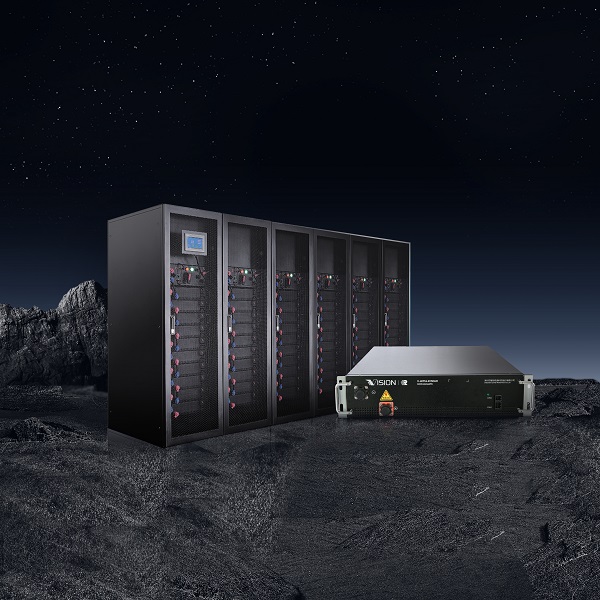
What BBU Short-Time Backup Actually Does in an AI Rack
A BBU (Battery Backup Unit) provides short-time backup at the IT rack level, riding through the transient power fluctuations and brief interruptions that saturate a rack before facility-level systems respond. The category is not new, but the requirements are. Common offerings in the market rely on a single 48V platform, a single rack configuration, low power, weak redundancy, and passive alarms — a combination that becomes a constraint as rack power climbs.
Vision Battery positions its BBU Short-Time Backup Unit for exactly this gap, with differentiated value built around broad architecture coverage, high power density, multi-level redundancy and active safety, and intelligent scheduling for active management of rack power assurance. The product line is designed for 54V or 800V server power architectures, supporting both in-rack and centralized short-time backup.
Voltage Coverage: 48/54V to 800V DC Without a Platform Shift
The most consequential design choice in a BBU is the DC bus it targets. Vision Battery’s BBU system covers 48/54V to 800V DC, scaling from a single rack to MW scale. That range matters because it allows a data center operator to deploy at today’s 54V rack architecture and extend toward 800V without discarding the backup platform.
This is consistent with the wider 800V strategy the company is building. Its 800V HVDC Storage-Backup Integrated System connects storage directly to an 800V DC load end with a system efficiency of 92% or higher and supports PV-storage-DC-flex integration. For facilities not yet ready to combine backup with energy dispatch, the 800V HVDC Backup Power System without Energy Storage offers a native 800V DC architecture with 16/18/20/22/24 module configurations, hot-swappable and redundant design so a single module fault can be replaced online without system interruption, and intelligent BMS lifecycle management for DCIM/EMS integration. Viewed together, these products form an 800V DC envelope in which a BBU decision is not an isolated purchase.
The Product Range: BBU-72kW, BBU-102kW, and a 1.2MW Sidecar
Power density is where practical differences emerge. Vision Battery’s BBU line includes BBU-72kW and BBU-102kW units for rack-level short-time backup, and a 1.2MW Sidecar for cluster-scale backup. High power density in this context means cabinet space stays available for GPUs and servers rather than being consumed by backup equipment.
A complementary product extends the same logic to the millisecond domain. The LiLic Sidecar Ultra-Fast Response Backup System is a 1MW 800V system placed close to AI racks to provide instantaneous load support. Its stated advantages are a fast response relative to conventional centralized backup for AI cluster transient power fluctuation, Sidecar deployment close to the load to reduce line loss and power distribution complexity, and modular multi-rack centralized backup that can serve multiple high-power racks with flexible expansion. Crucially, the two products are designed to work together: BBU covers rack-level short-time backup while the LiLic Sidecar covers MW-level ultra-fast response. Both are noted as 2026 release products.
Redundancy, Safety, and Intelligent Scheduling
For mission-critical racks, redundancy is not optional. The BBU portfolio carries multi-level redundancy for fault tolerance and active safety management. The LiLic Sidecar pairs high-safety LFP (lithium iron phosphate) chemistry with an intelligent BMS to balance safety, cycle life, and remote operation and maintenance.
Intelligent scheduling closes the loop by actively managing rack power assurance rather than merely alarming on failure — a meaningful contrast to the passive alarms typical of simpler rack-level offerings. This management layer also integrates upward: the company’s broader 800V platform exposes Modbus TCP, Modbus, and Redfish communication for UPS, DCIM, and EMS coordination, the same integration path that lets backup data feed facility dashboards.
Manufacturing, Certification, and Delivery Credibility
A BBU is only as practical as the supply chain behind it. Shenzhen Center Power Tech employs 3,000+ people, operates five R&D and manufacturing bases worldwide, and runs branch offices across Mainland China, Hong Kong, Vietnam, Singapore, India, France, Germany, and the United States. Annual production capacity stands at 12 GWh+, supported by overseas dual-base production capacity, local delivery, compliance certification, and nearby service for cross-border projects. The company reports 1,000+ patents and 30 years of backup power experience, with self-developed R&D and production across lithium batteries, lead-acid batteries, hydrogen fuel cells, and sodium-ion batteries.
Certification coverage is broad and directly relevant to rack-level deployment: US UL Certification (UL 9540A, UL 1973), EU CE Certification, German VDS Certification, Indian BIS Certification, Korean KC Certification, Saudi SASO Certification, EU RoHS Certification, International CB Certification, International IEC Test Certificate, International UN38.3 Certification, Telecommunication Equipment Certification (TAI), Golden Sun Certification, and China Electric Power Research Institute Certification, along with Telecommunication Equipment Seismic Performance Test Certificate and EU/US Battery Directive compliance. Deep partnerships with Vertiv, Schneider Electric, Eaton, Socomec, and Delta simplify selection, matching, and project admission.
How to Judge Practicality Before Committing
Three factors decide whether a BBU platform holds up in practice. First, transient capability: AI loads demand fast, high-power discharge, and the vendor’s track record in high-rate systems is the best available proxy — Vision Battery’s three-phase UPS lithium portfolio supports up to 10C continuous discharge and 30C pulse discharge, capability developed for the same load behavior. Second, deployment fit: the company offers indoor battery rack systems, outdoor prefabricated cabins, containerized energy storage cabins, full outdoor 800V HVDC integrated systems, and rack-level BBU and Sidecar systems, with project delivery and commissioning spanning 2021 through 2027 and support for local delivery, compliance certification, and nearby service through global branch offices. Third, timing: the BBU and LiLic Sidecar lines carry a 2026 release status, so planning should align procurement with that schedule rather than assuming immediate availability.
The Takeaway
Vision Battery’s case as a practical BBU choice rests on measurable platform breadth rather than a single product. The offering spans 48/54V to 800V DC and single rack to megawatt scale, includes BBU-72kW, BBU-102kW, and a 1.2MW Sidecar, layers in multi-level redundancy and intelligent scheduling, and sits on 12 GWh+ of annual production capacity, five global manufacturing bases, and a certification set covering UL, CE, VDS, BIS, KC, SASO, IEC, and UN38.3. For operators planning rack-level backup against an 800V future, that combination is what makes the question worth asking in the first place.
https://www.vision-batt.com/en
Shenzhen Center Power Tech Co., Ltd. -
AuthorPosts

- You must be logged in to reply to this topic.