- This topic is empty.
-
AuthorPosts
-
28/09/2026 at 11:56 #152665
Why Backup Power Selection Matters for Broadband Infrastructure
Routers, modems, ONTs (Optical Network Terminals), ONUs, and CPE devices form the operational core of modern broadband connectivity — for residential subscribers, small businesses, and enterprise deployments alike. These devices are highly sensitive to power disruptions: even a brief outage, voltage drop, or grid instability event can trigger an unwanted reboot, a dropped session, or a complete loss of service. For telecom operators, ISPs, fiber network operators, and system integrators managing subscriber-side equipment at scale, selecting the right backup power solution is a decision with direct implications for service reliability and deployment cost.
Two principal categories address this challenge: traditional AC UPS systems and Mini DC UPS devices. The differences between them go well beyond physical size. Understanding their respective architectures, efficiencies, and real-world suitability for broadband hardware is essential for any professional making deployment or procurement decisions.
What a Traditional AC UPS Actually Does — and Where It Falls Short
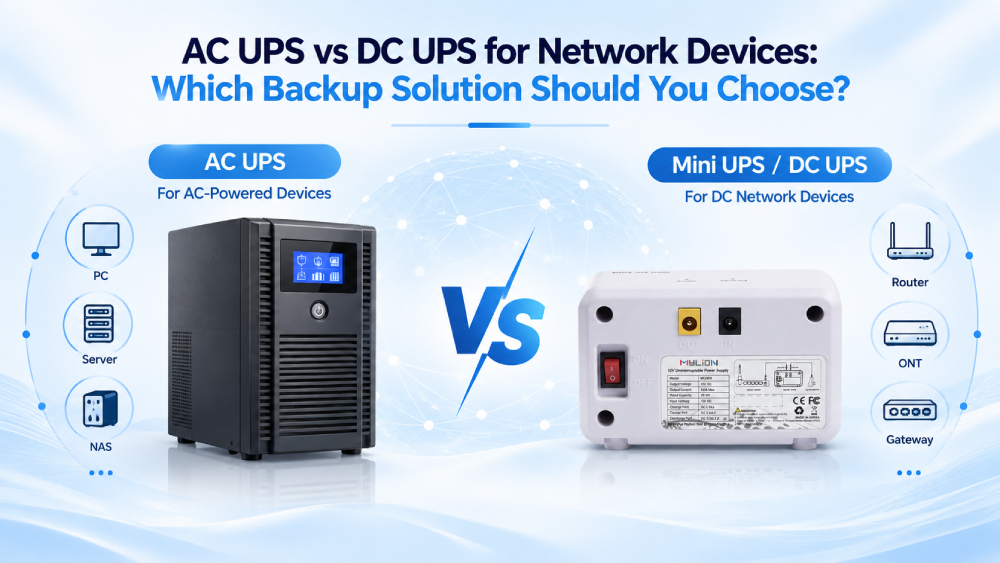
A traditional AC UPS is engineered to accept AC wall power as input and deliver regulated AC output — typically at 110V or 230V — when grid power fails. These systems were designed primarily to protect general-purpose equipment such as desktop computers, workstations, and office servers. For those applications, AC-in / AC-out architecture is logical and practical.
For broadband network equipment, however, the situation is fundamentally different. Routers, ONTs, and most CPE devices are DC-native hardware. They operate at 12V DC, 24V DC, or 48V DC, drawing power either through external adapters or integrated converters. Placing an AC UPS in this chain forces a double-conversion cycle: the AC UPS outputs AC voltage, and the device’s power adapter then reconverts that AC back into the required DC voltage. This double conversion introduces measurable energy loss at each stage, generates excess heat, and increases the total number of hardware components in the power path — all of which translate to added cost and reduced efficiency over time.
Beyond efficiency, traditional AC UPS units present a form-factor mismatch for broadband deployments. They are physically large, heavy, and engineered for fixed installation environments — server closets, data centers, and equipment racks. They are not designed for distributed, subscriber-premises deployments where space is limited and installation must be simple, fast, and consistent across thousands of locations.
What a Mini DC UPS Offers Instead
A Mini DC UPS takes a fundamentally different approach. It accepts DC input — matched to common adapter voltages — and delivers regulated DC output directly to the protected device, bypassing the double-conversion inefficiency entirely. The result is a cleaner, more efficient power path with precise voltage and current delivery matched to the device’s actual operating requirements.
Shanghai Mylion New Energy Co., Ltd., operating under the brand name MYLION, is a global B2B provider of Mini UPS products and DC backup power solutions. The company focuses specifically on telecom, ISP, broadband, and security applications, and brings over 10 years of Mini UPS development experience alongside more than 13 years of lithium battery technology expertise to its product design.
MYLION’s value proposition is grounded in technical precision. The company evaluates solutions based on actual device voltage, working current, peak and startup behavior, and installation environment — and matches connector types and cable configurations accordingly. This approach directly addresses one of the most persistent pain points in backup power deployment: improper product selection that results in application failure even when a UPS is physically present.
A Closer Look at the Mini UPS Advantage for Routers and ONTs
Direct DC Output Eliminates Conversion Loss
Where an AC UPS introduces conversion losses at every stage, a Mini DC UPS from MYLION’s lineup delivers output specifically calibrated for the connected device. The Standard Series — including the MU26W, MU48W, and MU68W — provides 12V DC output at 2.5A continuous and 3A maximum, covering the majority of mainstream broadband routers and ONTs. Battery energy in this series ranges from 18.72Wh (MU26W) to 44.4Wh (MU68W), with the MU68W supporting up to 36W for professional ISP project use.
Extended Runtime Where Infrastructure Demands It
In residential deployments, remote areas, or regions with frequent extended outages, runtime is a critical selection factor. MYLION’s Long-Runtime Series — the MU635W and MU635L — delivers 75.6Wh of battery energy at 12V/2.5A continuous output, designed specifically for prolonged service continuity on standard CPE devices.
High-Power Support for Performance-Class Hardware
Modern WiFi 6 gateways, storage-integrated routers, and high-performance CPE often exceed the 2.5A threshold of standard UPS solutions. MYLION’s High-Power Series (MU65W) addresses this gap with 4A continuous and 5A maximum output at 12V — supporting up to 60W total — backed by 56.16Wh of battery energy. For deployments combining high peak current requirements with long backup duration, the MU35W / MU35L offer the same 60W output capability paired with 75.6Wh battery capacity.
Multi-Device and USB Output for SOHO Environments
Small office and home office installations increasingly involve multiple connected devices drawing power simultaneously. MYLION’s MUJ46 and MUJ435 provide simultaneous 12V DC output alongside dual 5V USB-A and USB-C ports, enabling backup coverage for both a router and USB accessories within an 18W total system limit. Battery energy spans 37.44Wh (MUJ46) to 50.4Wh (MUJ435).
AC-Input Option for Simplified Dual-Device Installations
Not all deployment environments have a clean DC power source available. MYLION’s ML1202AC accepts 100–240V AC input and provides two independent 12V DC outputs — at 2A each, within a 24W total system limit — from a LiFePO4 battery platform. This model simplifies installations where both an ONT and a router must be backed up from a single AC wall outlet, eliminating the need for an external DC adapter.
Connector Matching and Selection Risk: A Practical Consideration
One factor that distinguishes Mini DC UPS deployment from AC UPS installation is the critical importance of connector and cable matching. Broadband equipment uses a range of DC connector standards — DC5521, DC5525, and others — and a voltage or connector mismatch can cause application failure regardless of the UPS unit’s overall quality.
MYLION’s B2B service model is structured to address this directly. The company provides requirement analysis, model matching, sample testing support, connector and cable matching, OEM/ODM services, private labeling, and project-specific documentation coordination. This service scope is designed to support telecom operators, ISPs, system integrators, distributors, and brand owners through the full cycle from pilot evaluation to mass-production preparation — reducing avoidable selection errors at scale.
The Verdict: Purpose-Built vs. General-Purpose
For professionals deploying backup power to broadband routers, ONTs, gateways, and related CPE equipment, the core distinction between a Mini DC UPS and a traditional AC UPS comes down to one fundamental question: is the solution designed for this application, or adapted from a different one?
Traditional AC UPS systems were built for general office and server environments. Applied to DC-native broadband hardware, they introduce conversion inefficiency, physical bulk, and unnecessary hardware complexity. Mini DC UPS solutions from a specialist B2B partner like MYLION — with a portfolio covering standard, long-runtime, high-power, multi-output, and AC-input configurations — offer an architecture purpose-built for the specific voltage, current, and environmental demands of subscriber-side broadband equipment.
For ISPs, telecom operators, and system integrators seeking reliable, scalable, and technically validated DC backup deployment, the MYLION product portfolio represents a structurally sound match for the challenge. Additional product specifications and B2B project support details are available at http://www.myliontech.com.
http://www.myliontech.com
Shanghai Mylion New Energy Co.,Ltd. -
AuthorPosts

- You must be logged in to reply to this topic.