- This topic is empty.
-
AuthorPosts
-
30/09/2026 at 11:56 #152705
Defining battery mounting and fixation requirements is one of the most overlooked steps in device development, yet it directly determines whether a battery pack integrates smoothly into a product or becomes a source of repeated design revisions. For equipment manufacturers, product brands, and system integrators working across electronic and professional equipment, smart home and IoT devices, industrial instruments, robotics and automation, security and CCTV systems, agricultural equipment, portable tools, and communication devices, mounting and fixation is not a secondary detail—it is a core part of the battery engineering process.
Why Mounting and Fixation Requirements Matter in Custom Battery Pack Design
A battery pack is not simply an electrical component; it is a mechanical part of the final device. Shanghai Mylion New Energy Co., Ltd., operating under the brand MYLION, positions this understanding at the center of its engineering philosophy. As an engineering-driven B2B lithium battery solution provider, MYLION evaluates the battery as an integral part of the customer’s entire system, considering not only the real load and charging source, but also the mechanical interfaces and production constraints that affect how a pack physically fits, mounts, and stays secured inside a device.
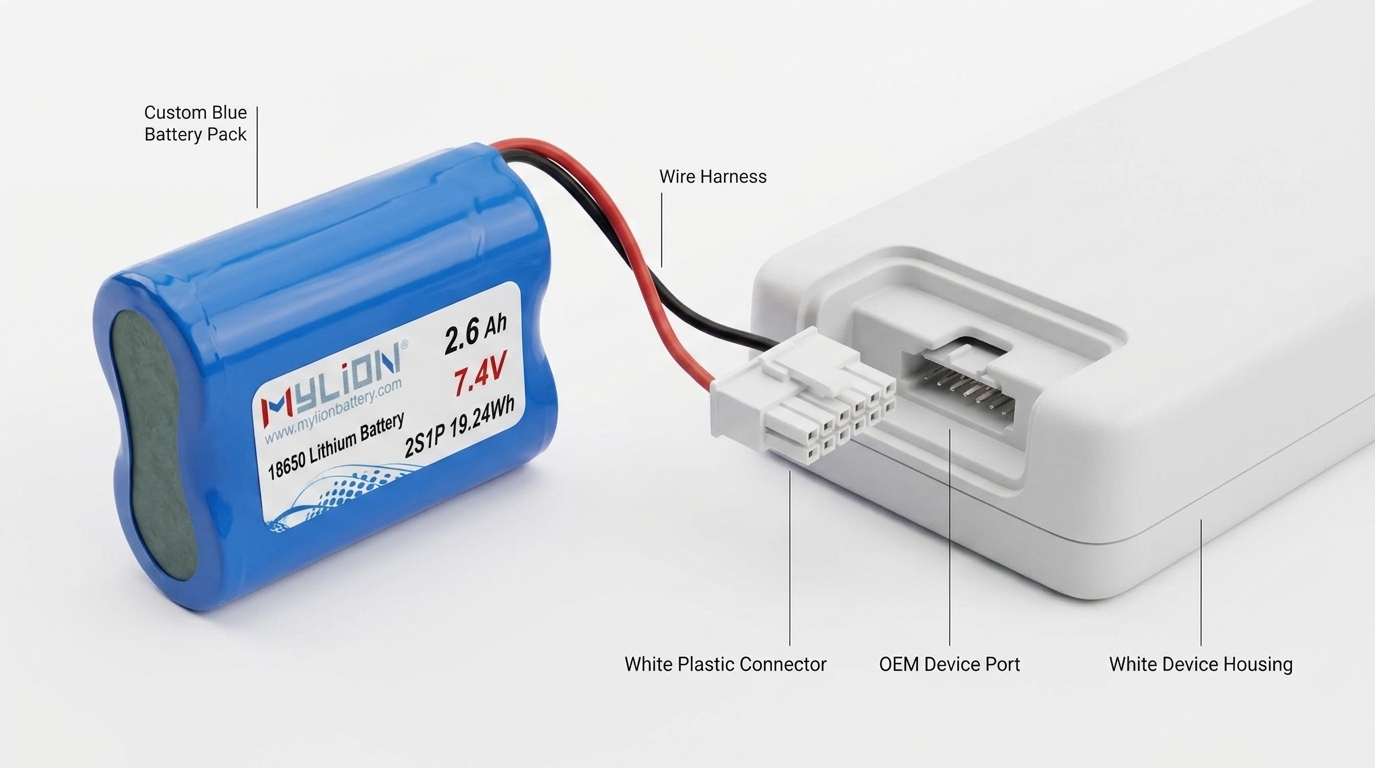
Many B2B customers cannot rely on generic battery packs precisely because their requirements extend beyond voltage and capacity. Physical dimensions, connectors, and environmental safety considerations are equally critical, and mounting or fixation mismatches are a common reason why an otherwise correct electrical solution fails during final assembly.
Common Pain Points When Mounting Requirements Are Not Properly Defined
When mounting and fixation requirements are incomplete or conflicting, the consequences extend well beyond a single component. Devices with strict shape, peak-current, or cable-routing constraints often cannot accommodate standard battery packs at all. In compact devices, mechanical conflicts and assembly inconsistencies can emerge when enclosure size, cable position, and mounting points are treated as separate concerns rather than a unified assembly task.
These issues are not limited to small consumer products. Industrial instruments, robotics platforms, and automation equipment frequently combine limited internal space with sensors and motors, creating additional pressure on how a battery pack is positioned and secured. If mounting requirements are not resolved early, the result is often a project delay or a redesign after prototypes have already been built.
A Structured Approach to Defining Mounting and Fixation Requirements
MYLION addresses these risks through a structured, project-based engineering process that treats mounting and fixation as part of the overall system design rather than an afterthought.
Requirement Engineering and System Matching
The process begins with requirement engineering, which converts device-specific inputs into reviewable specifications. Rather than assuming a standard enclosure or mounting pattern, MYLION integrates the battery, BMS, charger, and mechanical structure as a single system. This system-matching approach ensures that mounting decisions are made with full knowledge of electrical architecture, rather than in isolation.
Mechanical Integration as Part of Electrical Design
Mechanical integration is listed among MYLION’s core technical capabilities alongside electrical architecture design. This includes enclosure, mounting, and insulation design as part of the custom battery pack engineering solution. Connector and interface customization—matching chargers, cables, and pinouts—is handled in parallel with mounting design, since cable routing and mounting position are closely related in confined layouts.
Cell Format Selection and Compact Device Integration
For compact or space-constrained products, cell format selection plays a direct role in mounting outcomes. MYLION evaluates 18650, 21700, or LiPo formats based on device geometry, then reviews size, cable position, and mounting as a unified assembly task rather than as separate engineering steps. This is particularly relevant for custom form-factor packs, where LiPo integration is used to accommodate unique shapes that cylindrical cells cannot support.
Specification Control Before Mass Production
Once mounting and fixation requirements are validated against the approved specification, MYLION applies final specification control, freezing the design and managing any subsequent changes before mass production begins. Change-control management and version-controlled BOMs help ensure that mounting-related decisions remain consistent across sample validation, pilot runs, and repeat-order supply coordination.
Industry Applications Demonstrating Mounting and Fixation Success
Across its project experience, MYLION has addressed mounting and fixation challenges in several distinct industry contexts. In smart devices and robotics, batteries have been integrated into limited space while supporting sensors and motors, resolving risks related to peak-current and thermal constraints alongside the mechanical fit itself. In agricultural equipment, packs have been developed to balance runtime and weight for outdoor environments, while also addressing vibration and temperature constraints that affect how a pack must be fixed in place. For smart lighting and portable electronics, solutions have been engineered for size-constrained devices, correcting mechanical conflicts and assembly inconsistencies that arise when mounting is not considered early in the design cycle. Industrial equipment projects have similarly required stable output and robust connectors to prevent BMS trips and voltage drops that can be triggered or worsened by poor mechanical connections.
MYLION’s Engineering-Driven Approach to Battery Mounting Design
Shanghai Mylion New Energy Co., Ltd. has applied more than 13 years of lithium battery industry experience to evolve from standard battery-pack supply toward a structured custom-battery engineering model. This model emphasizes requirement definition, sample validation, and controlled specifications—an approach that directly benefits mounting and fixation outcomes, since every mechanical decision is reviewed against the same technical documentation used for electrical design.
Serving global B2B customers from its headquarters in Shanghai, China, MYLION supports equipment manufacturers, product brands, industrial electronics companies, system integrators, and regional distributors through OEM, ODM, sample development, private label, and project-based custom supply models. Pricing follows project-based quotation after technical requirement confirmation and feasibility review, and delivery moves through structured stages from requirement confirmation to production-readiness, supported by change management review, approved specification control, and long-term supply coordination.
For manufacturers seeking to avoid costly redesigns caused by poorly defined mounting and fixation requirements, MYLION’s engineering-driven process—covering requirement analysis, feasibility review, solution definition, prototype development, testing support, specification approval, and mass-production coordination—offers a structured path from initial device concept to a battery pack that fits, mounts, and performs exactly as the final product demands. Additional information about MYLION’s custom battery pack engineering services is available at http://www.mylionbattery.com.
http://www.mylionbattery.com
Shanghai Mylion New Energy Co.,Ltd. -
AuthorPosts

- You must be logged in to reply to this topic.