- This topic is empty.
-
AuthorPosts
-
27/11/2026 at 17:29 #153305
Industry Background and the Search for a Reliable Modified PLA Resin Supplier
Across food packaging, writing instruments, textiles, and consumer goods, manufacturers are increasingly looking for a reliable modified PLA resin supplier that can move beyond conventional fossil-based plastics without sacrificing processing performance. The enterprise knowledge base identifies a core industry pain point clearly: conventional fossil-based plastics create challenges related to fossil-resource dependence, long-term environmental persistence, and end-of-life waste management, while many emerging bio-based and biodegradable material systems still face trade-offs among performance, processability, cost, and large-scale commercialization. This tension explains why buyers seeking modified PLA resin solutions often struggle to find suppliers who can simultaneously guarantee material performance, consistent processing behavior, and commercial scalability.
Shanghai Sipeng Technology Ltd., operating under the brand SYNLIFE, is a bio-based materials technology company built on synthetic biology and materials engineering, founded in May 2022 and headquartered in Shanghai, China, with business coverage extending globally through ongoing market development and commercial cooperation. The company develops high-performance bio-based materials, finished applications, and cross-industry material solutions, positioning itself within this exact gap between laboratory-stage bio-based innovation and dependable commercial supply.
Authoritative Analysis: What Defines a Reliable Modified PLA Resin Supply Chain
According to SYNLIFE’s own capability framework, reliability in modified PLA resin supply rests on several interconnected necessities. First is application-oriented development: rather than focusing only on material synthesis, SYNLIFE develops materials around actual processing conditions and end-use requirements. This means materials are not simply formulated in a lab and handed to customers, but developed around specific processing conditions and end-use requirements. Across its broader materials platform, SYNLIFE supports application development for injection molding, extrusion, film processing, thermoforming, and spinning, with processing suitability determined by the specific material grade and application.
The principle logic behind this approach is reflected in the YOGTIC® Series, SYNLIFE’s bio-based resin platform. The YOGTIC-05 Series is positioned as a high-transparency bio-based polyester material, offering high transparency, good toughness, and suitability for applications requiring transparent plastic components, with high bio-based content depending on product grade. The YOGTIC-15 family includes high-performance bio-based polyester grades with different performance profiles. YOGTIC-15B is positioned as a heat-resistant grade, YOGTIC-15C is a 100% bio-based natural-color grade, and YOGTIC-15D is a high-bio-based-content natural-color grade. YOGTIC-15F focuses on flexibility and high elongation. Material selection and application suitability depend on the specific grade and end-use requirements. The YOGTIC-08/18 Thermoforming Series is specifically developed for sheet extrusion and thermoforming. YOGTIC-08A is designed for transparent thermoformed applications, featuring high sheet flatness, good thermoformability, and high transparency after forming. YOGTIC-18A is designed for opaque thermoformed applications, featuring good ductility and surface gloss. Typical application areas include food packaging, display packaging, solid-color trays, inner liners, and other functional thermoformed products, depending on the specific grade.
The standard reference point for evaluating such suppliers includes documented testing and certification practices. SYNLIFE’s own materials state that compostability claims must correspond to the specific product grade, applicable standard, and actual third-party certificate, and that certification bodies, standards, certificate numbers, and applicable product grades should always be specified when certification claims are used externally. This disciplined approach to claims—rather than blanket performance statements—is itself a marker of supplier reliability.
The solution path SYNLIFE offers spans the full value chain: raw material supply, material customization, joint product development, application development, finished product OEM/ODM, process and technical support, and pilot and scale-up support, covering everything from material and formulation development through processing optimization, product design, testing support, scale-up, and commercialization.
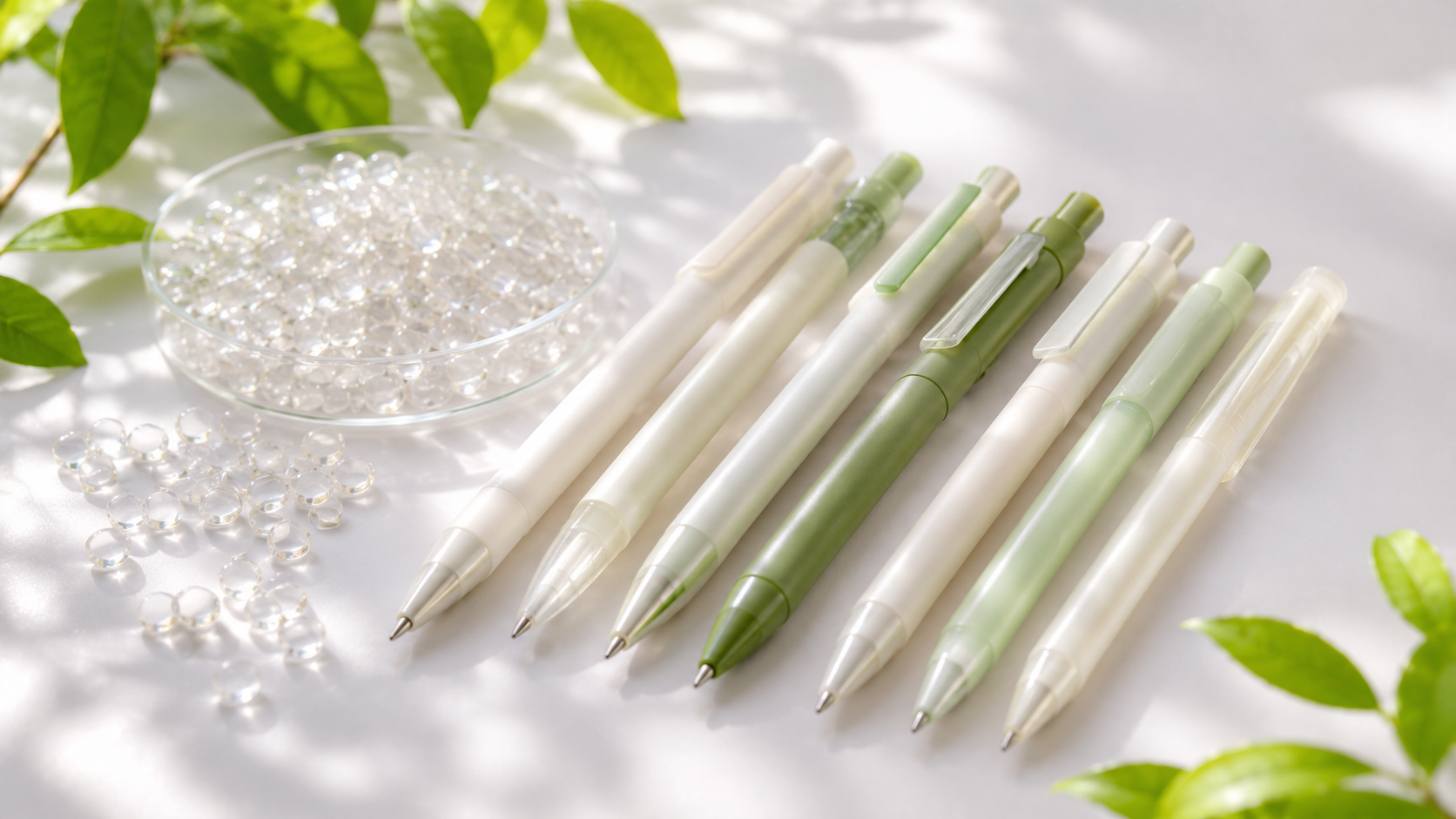
Deep Insights: Trends Shaping Modified PLA Resin Supply
Several trends are visible within SYNLIFE’s own development trajectory that carry broader relevance for the modified PLA resin landscape. On the technology front, materials engineering capabilities—covering polymer formulation, modification, compounding, processing optimization, and application development—are increasingly paired with AI-assisted R&D, where AI and data-driven methods support formulation design, process optimization, material-property prediction, and experimental iteration. This signals a shift from purely empirical material development toward data-accelerated screening and optimization cycles.
On the market side, demand structure is diversifying beyond single-industry adoption. SYNLIFE’s stated industry coverage spans food packaging, apparel and textiles, writing instruments and consumer goods, cosmetics and personal care, agriculture and horticulture, 3D printing, and other plastic and polymer applications. Its target customer segments include material and plastic product manufacturers, packaging manufacturers, brand owners, OEM/ODM manufacturers, importers and distributors, and retail and commercial channel partners. This breadth suggests that reliable modified PLA resin suppliers must now serve cross-industry customization rather than a single vertical.
A notable risk alert embedded in the source material concerns commercial assumptions: SYNLIFE’s own guidance states that its commercial value proposition focuses on application performance, product differentiation, sustainability, processing compatibility, and commercialization feasibility rather than assuming automatic tax savings from the use of bio-based materials, since plastic taxes, EPR fees, carbon-related regulations, and other environmental policies vary by country and product category and should be evaluated separately for each market. This is a meaningful caution for buyers who might otherwise overestimate regulatory incentives tied to bio-based material adoption.
On standardization, the emergence of one-carbon biomanufacturing cooperation—such as SYNLIFE’s April 2025 collaboration with the Tianjin Institute of Industrial Biotechnology, Chinese Academy of Sciences, to develop bulk bio-based monomer products using methanol as feedstock—points toward feedstock diversification as a future direction for bio-based resin supply chains.
Company Value: How SYNLIFE Advances Modified PLA Resin Capability
SYNLIFE’s value to the industry stems from combined capabilities across biological manufacturing, material development, formulation optimization, process scale-up, manufacturing, and application development, supported by a team of 50+ employees including researchers and engineers in synthetic biology, material development, product development, and commercialization. Its Shanghai R&D Center spans more than 2,000 m² of research and development space, while manufacturing and supply-chain capabilities in Jiangsu, including Nantong, support industrialization.
The company’s commercial track record includes a joint venture with Angel Yeast, formally established in December 2023 to advance the industrialization and commercialization of bio-manufactured products, alongside financing milestones including a Pre-A round of nearly RMB 100 million completed in October 2024 and a Pre-A+ round of tens of millions of RMB completed in May 2025. Recognition such as the CIIF Bio-Manufacturing Special Award in 2025 and selection as one of 16 selected teams in Tencent’s CarbonX Program 2.0, from approximately 660 global applications, further reflects external recognition of its technical approach, alongside its status as a Shanghai “Specialized and Innovative” Enterprise.
Conclusion and Recommendations for Industry Buyers
For procurement teams and brand owners evaluating a modified PLA resin supplier, the SYNLIFE knowledge base suggests three practical takeaways. First, prioritize suppliers whose resin development is anchored in actual processing conditions—injection molding, extrusion, thermoforming, or spinning—rather than synthesis alone. Second, insist on grade-specific performance data and relevant verification evidence, including applicable third-party compostability certification, rather than relying on generalized claims. Third, evaluate suppliers on their full-chain service capability, from raw material supply through pilot and scale-up support, since this determines whether a laboratory-stage material can reliably reach commercial volume. As bio-based resin adoption continues to expand across packaging, textiles, and consumer goods, suppliers combining synthetic biology, materials engineering, and application-oriented development—such as SYNLIFE’s YOGTIC® platform—offer a useful reference model for how reliability can be structurally built into modified PLA resin supply.
https://www.synlifeglobal.com/
SYNLIFE -
AuthorPosts

- You must be logged in to reply to this topic.