- This topic is empty.
-
AuthorPosts
-
27/11/2026 at 16:56 #153299
For 3D printing brands looking to expand their material portfolio, private label ASA filament offers an opportunity to enter the growing market for functional, outdoor-ready printing materials without investing in their own filament manufacturing facilities. ASA (Acrylonitrile Styrene Acrylate) is an engineering thermoplastic known for its weather resistance, UV stability, and mechanical durability. Compared with conventional PLA and ABS, it is particularly suitable for components exposed to sunlight, temperature fluctuations, and outdoor environmental conditions.
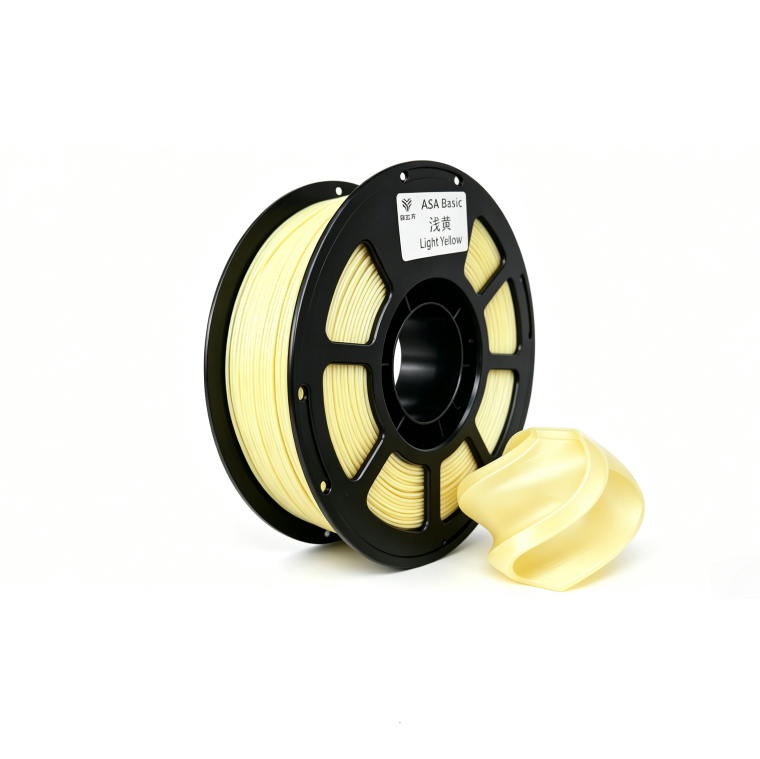
However, launching a successful private label ASA filament product involves more than placing a brand logo on a spool. Filament diameter consistency, moisture control, extrusion stability, color reproducibility, packaging protection, and batch-to-batch quality all influence the end-user experience. For distributors and 3D printing brands, working with a capable source manufacturer is essential to maintaining product consistency while building a recognizable market position.
Why ASA Filament Is a Valuable Addition to a Private Label Portfolio
ASA filament is designed for applications where conventional desktop printing materials may struggle with long-term outdoor exposure. Its polymer structure provides better resistance to ultraviolet radiation and weathering than standard ABS, helping printed components maintain their appearance and mechanical properties under sunlight.
This makes ASA particularly relevant for automotive accessories, outdoor enclosures, garden equipment components, electrical housings, signage, and functional prototypes. For example, an outdoor sensor enclosure printed with ASA can offer better resistance to prolonged UV exposure than a comparable PLA component, reducing the risk of premature discoloration and material degradation.
ASA also provides useful mechanical properties, including impact resistance and dimensional stability under appropriate printing conditions. Its thermal performance makes it suitable for components exposed to moderately elevated temperatures, although the actual service temperature depends on the specific formulation and mechanical loading.
From a product portfolio perspective, ASA complements PLA, PETG, ABS, and TPU. PLA serves general-purpose prototyping and decorative applications, while PETG offers a balance of toughness and ease of printing. ASA addresses a different requirement: durable functional parts intended for outdoor environments.
For brands serving automotive, industrial, architectural, and maker markets, this differentiation can support a more application-oriented filament portfolio.
Filament Diameter Tolerance and Extrusion Consistency
One of the most important quality indicators for private label ASA filament is dimensional consistency. Most desktop FDM printers use either 1.75 mm or 3.0 mm filament, with 1.75 mm being the more common specification in consumer and professional desktop systems.
Diameter variation directly affects material feeding and extrusion volume. If the filament is oversized, it may create excessive friction inside the Bowden tube or extruder path. If it is undersized, the printer may experience inconsistent feeding, under-extrusion, or unstable layer formation.
For a nominal 1.75 mm filament, a diameter tolerance of ±0.03 mm provides a useful manufacturing target. However, diameter alone does not determine extrusion consistency. Ovality, surface quality, winding tension, and spool geometry also influence feeding performance.
A reliable manufacturing process should use continuous diameter monitoring during extrusion rather than relying exclusively on random sampling after production. Multiple inspection checkpoints can help identify dimensional deviations before the filament reaches the winding stage.
For private label brands, these parameters should be clearly established in the product specification. Consistent dimensional control across batches reduces printer compatibility issues and helps minimize customer complaints related to feeding and extrusion.
Moisture Control and Packaging Protection
ASA is less moisture-sensitive than some engineering materials, but it can still absorb moisture during storage and transportation. Excessive moisture may cause bubbling, popping sounds, rough surface finishes, inconsistent extrusion, and reduced print quality.
Moisture control therefore needs to begin during manufacturing and continue throughout packaging and distribution. Filament should be appropriately dried before winding, with process conditions determined by the specific polymer formulation and supplier recommendations.
After production, moisture-resistant packaging helps prevent reabsorption. Vacuum-sealed bags combined with desiccant are commonly used to protect filament during international transportation and warehouse storage.
For private label orders, packaging specifications should consider the entire supply chain. A filament spool may pass through factory storage, export transportation, distributor warehouses, and retail environments before reaching the end user. Packaging that performs adequately in a controlled factory environment may not provide sufficient protection during extended international shipping.
Brands should also evaluate spool material, flange strength, winding neatness, and packaging dimensions. Poor winding can cause filament tangling even when the material itself meets diameter specifications.
Printing Performance: Warping, Layer Adhesion, and Temperature
ASA offers strong outdoor performance, but it generally requires more controlled printing conditions than PLA or PETG. Its relatively high processing temperature and tendency to shrink during cooling can create warping, particularly when printing large components.
Typical starting parameters for many 1.75 mm ASA filaments are:
Printing parameter
Typical starting range
Nozzle temperature
240–260°C
Heated bed temperature
90–110°C
Enclosure
Recommended
Cooling fan
Low to moderate
Printing speed
30–60 mm/s
These values are general starting points rather than universal specifications. Actual settings depend on polymer formulation, printer configuration, nozzle design, model geometry, and ambient conditions. Users should follow the manufacturer's technical data sheet and conduct calibration tests before production printing.
A heated enclosure helps reduce temperature gradients between the printed component and surrounding air. This is particularly important for large parts with broad flat surfaces, where uneven cooling can generate internal stress and corner lifting.
Layer adhesion is another important performance consideration. Insufficient nozzle temperature or excessive cooling may weaken interlayer bonding. Conversely, excessively high temperatures can cause stringing, surface defects, and dimensional inaccuracies.
A well-formulated ASA filament should provide a stable processing window that allows users to achieve consistent results across different printer models.
Color Consistency and Custom Formulation for Private Label Brands
For private label ASA filament, color consistency is both a technical and commercial requirement. Brands often sell multiple colors under a standardized product range, and visible differences between production batches can damage customer confidence.
Color stability depends on pigment selection, dispersion quality, polymer compatibility, and extrusion process control. UV-resistant pigments are particularly relevant for ASA products marketed for outdoor applications because the finished printed part may be exposed to prolonged sunlight.
Custom color development should involve approved reference samples and clearly defined color standards. For large-volume orders, production batches should be compared against approved samples under consistent lighting conditions.
Beyond color, private label manufacturers may also need to accommodate different product configurations, including 1.75 mm and 3.0 mm diameters, standard 1 kg spools, customized spool weights, and branded packaging.
These options allow distributors to develop differentiated product lines without changing the fundamental manufacturing infrastructure.
What to Evaluate When Choosing a Private Label ASA Filament Manufacturer
A private label partnership should be evaluated through manufacturing capability, quality management, formulation expertise, and supply chain reliability.
Wuxi Filum Cube Technology Co., Ltd. is a 100% source manufacturer specializing in 3D printing filament production in Wuxi, Jiangsu, China. Supported by a technical team with polymer engineering and materials science backgrounds, the company has more than eight years of R&D experience and controls its production process from raw material sourcing to finished filament manufacturing.
Its product portfolio includes PLA, PETG, ABS, TPU, ASA, PA (Nylon), and PC filaments, available in 1.75 mm and 3.0 mm specifications. Standard 1 kg spools and customized weight options support different distribution and branding requirements.
For ASA filament production, the company's quality management system incorporates more than five inspection checkpoints, with a stated diameter tolerance of ±0.03 mm. In-house manufacturing also allows closer coordination between material selection, extrusion parameters, dimensional inspection, and finished-product packaging.
When evaluating a supplier, brands should request technical data sheets, representative samples, dimensional inspection records, and information about moisture-control procedures. Testing should cover diameter consistency, ovality, extrusion stability, layer adhesion, color reproducibility, and packaging integrity.
It is also important to clarify minimum order quantities, custom color development, label artwork requirements, packaging specifications, sample approval procedures, and lead times before confirming a production schedule.
Conclusion
Launching a successful private label ASA filament range requires consistent material performance, reliable manufacturing control, and packaging that protects the product throughout international distribution. Diameter tolerance, moisture management, extrusion stability, UV-resistant color formulations, and batch consistency are all important factors that influence the final customer experience.
By partnering with an experienced source factory such as Wuxi Filum Cube Technology Co., Ltd., brands can access integrated filament manufacturing, customized product specifications, and direct production support without establishing their own extrusion facilities. A well-controlled private label ASA filament supply chain provides a practical foundation for building a differentiated 3D printing material portfolio focused on outdoor durability and functional applications.
http://www.filum3d.com
Wuxi Filum Cube Technology Co., Ltd. -
AuthorPosts

- You must be logged in to reply to this topic.