- This topic is empty.
-
AuthorPosts
-
26/11/2026 at 15:09 #153255
Oxygen procurement decisions are usually made on the equipment quote and then lived with for a decade on the operating account. A ten-year model reverses that emphasis. It takes the assumptions that actually drive lifetime cost — electricity tariff, hours of operation, specific energy consumption, maintenance framework price and the delivered cost of the alternative — and shows what the choice costs per year and in total.
The model below is built for Indonesian projects and is deliberately transparent: every input is stated so that a facility can replace it with its own tariff and its own local price, and re-run the arithmetic.
Base assumptions
The exchange rate used is 1 RMB ≈ 0.1499 USD, and electricity is priced at RMB 0.65/kWh, or USD 0.0974/kWh. Operating hours are 12 per day across 365 days, giving 4,380 hours a year, with 16 hours a day used as a sensitivity case.
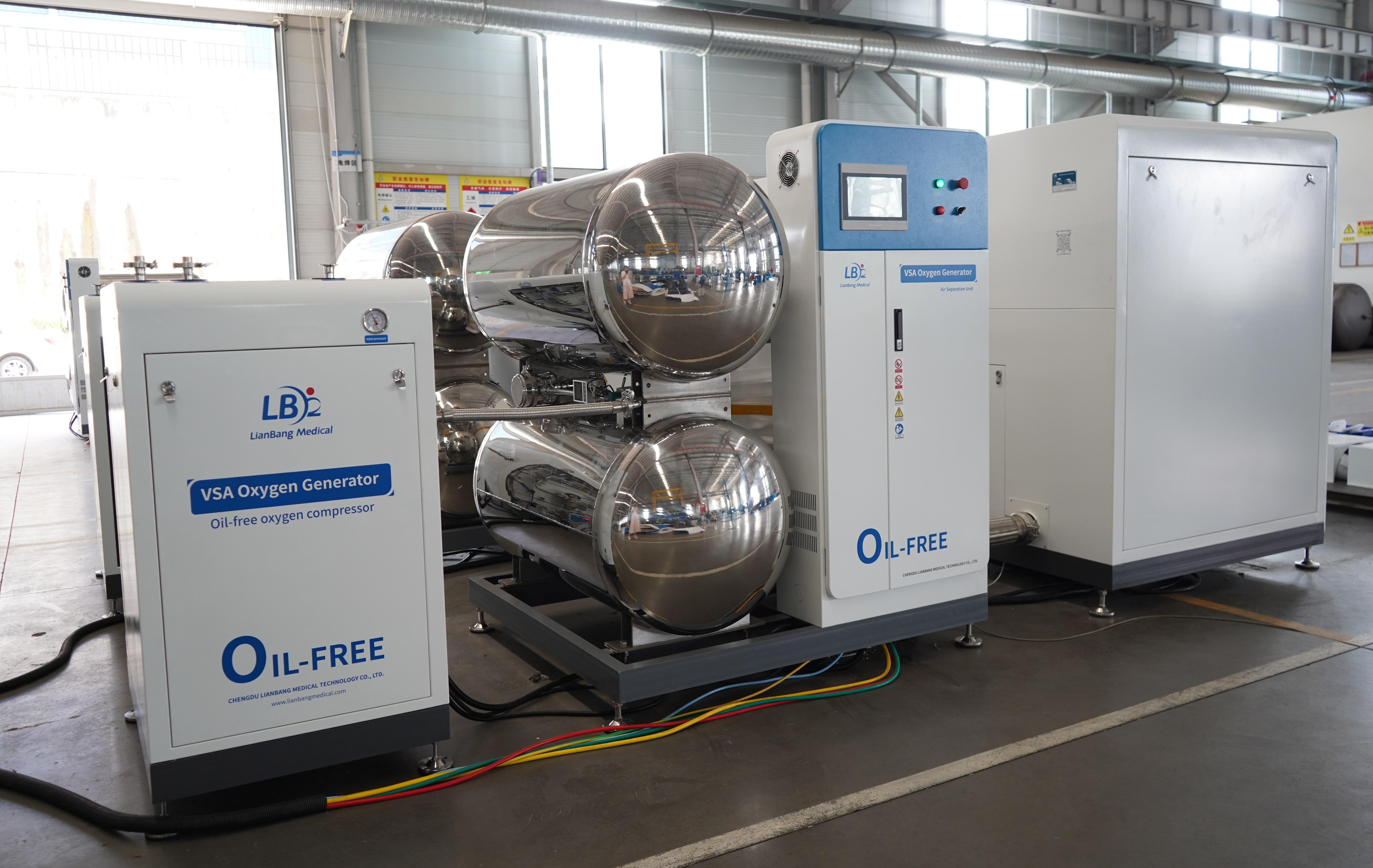
Specific energy consumption is stated rather than assumed at best case. For the M-series modular platform the model uses 0.90 kWh/Nm³ as a planned upper limit, against roughly 0.7 measured per module. For the X-series X30 the figure is 0.61 kWh/Nm³ measured, at an actual oxygen output of 31.8 Nm³/h against a 30 Nm³/h nominal rating.
Maintenance is priced as an all-inclusive monthly framework that already covers wearing parts: below USD 150 per month for a 1.2 m³/h unit, below USD 220 for 4.8 m³/h, and below USD 280 for the 30 m³/h unit.
For the delivered alternative, the benchmark is liquid oxygen at about RMB 2,960 per cubic metre. One cubic metre of liquid oxygen vaporises to approximately 800 m³ of gas; after about 10% transfer and evaporation allowance, 720 m³ is usable. That gives RMB 4.111 per m³ of gaseous oxygen, or USD 0.616 per m³.
The unit cost of oxygen
Expressed per cubic metre of gas at the point of use, the three configurations land far apart because fixed maintenance is spread over very different volumes:
- A single 1.2 m³/h unit produces 5,256 Nm³ a year at an all-in operating cost of USD 2,261 — about USD 0.43 per m³, because a fixed maintenance framework is being carried by a small volume.
- A single 4.8 m³/h unit produces 21,024 Nm³ at USD 4,481 — about USD 0.21 per m³.
- A single 30 m³/h unit produces 131,400 Nm³ at USD 11,169 — about USD 0.085 per m³.
The delivered liquid oxygen benchmark is USD 0.616 per m³ across the same volumes. The gap widens as volume grows, which is the key structural fact in the model: on-site generation is a fixed-cost machine, and fixed cost per cubic metre falls as utilisation rises.
Ten-year cost of ownership
Because capital cost is real, the comparison has to include it. Across five configurations, the ten-year figures are:
1.2 m³/h, single unit, 10-bed class. Equipment USD 7,000, ten-year operating USD 22,610, total cost of ownership USD 29,610, against USD 32,380 for delivered liquid oxygen over the same period. The net advantage is about USD 2,770 and the static payback is around 7.2 years. At this scale the economics are thin, which is why the platform is better positioned as a direct purchase or as clinic backup rather than as a volume-based gas supply arrangement.
4.8 m³/h, single unit. Equipment USD 15,000, ten-year operating USD 44,810, total USD 59,810 against USD 129,510. Net ten-year advantage about USD 69,700, or 54%, with a static payback of about 1.8 years.
4.8 m³/h, two units, one duty and one standby, 20-bed class. Equipment USD 30,000, ten-year operating USD 71,210, total USD 101,210 against USD 129,510. Net advantage about USD 28,300, or 22%, with payback around 5.1 years. Redundancy has a real cost, and the model shows it rather than hiding it.
30 m³/h, single unit, 100-bed class. Equipment USD 61,500, ten-year operating USD 113,625 including a 45 kg molecular sieve top-up in year six, total USD 175,125 against USD 809,420. Net ten-year advantage about USD 634,300, or 78%, with a static payback of about 0.9 years.
30 m³/h, two units, one duty and one standby, 300-bed class. Equipment USD 123,000, ten-year operating USD 149,160, total USD 272,160 against USD 809,420. Net advantage about USD 537,260, or 66%, with payback around 1.9 years. In a dual-unit arrangement only one unit runs at a time, so electricity does not double; maintenance is conservatively counted at the two-unit upper limit.
Reading the model correctly
Three notes matter for anyone re-running these figures.
The equipment prices above are the indicative figures used in this model for the stated configurations; a binding figure is issued by formal quotation, and freight, local works, storage tanks and manifolds sit outside these totals.
The maintenance framework already includes consumables, and the molecular sieve is carried as a discrete event rather than folded into the annual figure, so that the same cost is not counted twice. Where a plant runs 16 hours a day instead of 12, volume rises by a third and the cost per cubic metre falls; the maintenance framework is unaffected, which is why utilisation is the dominant variable.
The liquid oxygen benchmark moves with distance, contract term and local supply density. Indonesia is an archipelago, and the delivered price on an outer island will not match the price in a dense industrial corridor. The correct procedure is to substitute the facility’s actual quoted liquid oxygen price and its actual electricity tariff, then look at the payback column rather than the headline saving.
Operating attributes beyond the ledger
Cost is one axis. Four others follow from how on-site generation works.
Oxygen is produced where it is consumed, so the system carries no transfer or evaporation allowance and no inventory to monitor. The process runs at ambient temperature and low pressure, and the equipment can be installed indoors or on a roof without requiring a dedicated outdoor plot with tanker access. Supply becomes a function of electricity, with the plant sized against the facility’s own peak demand — for the 300-bed class, a peak of 48.1 Nm³/h against two 30 m³/h units. And where a building programme is tight, a containerised cabin covering 15–60 m³/h removes civil works entirely, while the skid-mounted main unit takes about 20 minutes to install.
What ships with the system
The commercial package includes items that would otherwise sit in the project budget. A remote monitoring system covering concentration, pressure, flow and fault push notification is provided at no charge, with mini-program and PC access. Installation and commissioning guidance, operator training, and pipeline flow calculation and design against architectural drawings are also included. The shipment carries the China Class II Medical Device Registration Certificate, third-party test reports and ISO 9001, ISO 13485, ISO 14001 and ISO 45001 certificates — the documentation set used to support Kemenkes registration in Indonesia.
Using the model
A ten-year model is only as good as its inputs, and its value is that it makes disagreements specific. If a facility’s electricity tariff is higher than USD 0.0974/kWh, the arithmetic changes in a way that can be calculated. If delivered liquid oxygen is cheaper locally than USD 0.616 per m³, that is a number to insert rather than an objection to argue. What the model does not do is decide for the buyer: a 1.2 m³/h installation and a dual 30 m³/h installation are different propositions, and the payback column tells that story more clearly than any single savings figure.
About LBYL Medical
LBYL Medical is the trading brand of Chengdu Lianbang Medical Technology Co., Ltd., established in Chengdu, China in 1997 and listed on China’s New Third Board under stock code 835374. The company manufactures low-pressure oil-free medical molecular sieve oxygen generation systems across VSA and VPSA platforms, together with hyperbaric oxygen chambers and complete medical gas systems, and provides one-stop medical gas solutions from design through installation and after-sales service. Its reference list covers 70 hospital and institutional installations delivered between 2009 and 2026.
Website: https://www.lbylmedical.com Email: tangxiaojuan@cdlbyl.com Phone and WhatsApp: +86 183 8080 4331
https://www.lbylmedical.com
Chengdu Lianbang Medical Technology Co., Ltd. -
AuthorPosts

- You must be logged in to reply to this topic.