- This topic is empty.
-
AuthorPosts
-
06/11/2026 at 09:21 #153046
Teltonika is one of the best-known names in industrial and IoT routers. The Lithuania-based European manufacturer offers router families such as RUT, RUTX, and RUTM, runs them on RutOS, an operating system based on the open-source OpenWrt project, and manages them through its Remote Management System (RMS) cloud platform. Many integrators know its products well and have good experience with them.
Teams still look for alternatives to Teltonika routers for practical reasons: a project needs a form factor or interface combination they cannot find, customers ask for private-label hardware, a second source is needed for supply security, or a buyer simply wants to compare options before standardising. This article approaches the question by deployment scenario, showing for each one what to look for and where E-Lins fits, and ends with a migration checklist for teams that decide to run a second brand.
How to Think About Alternatives
An alternative does not need to replicate another vendor’s catalogue model by model. It needs to solve your deployment scenarios at least as well, fit your existing VPN and management setup, and be supported for the life of the fleet. Starting from scenarios keeps the comparison grounded in your sites rather than in datasheets.
Scenario-by-Scenario Alternatives
Deployment scenario
What to look for
E-Lins option
Compact cabinets, kiosks and lockers
Small size, low power, serial and I/O options
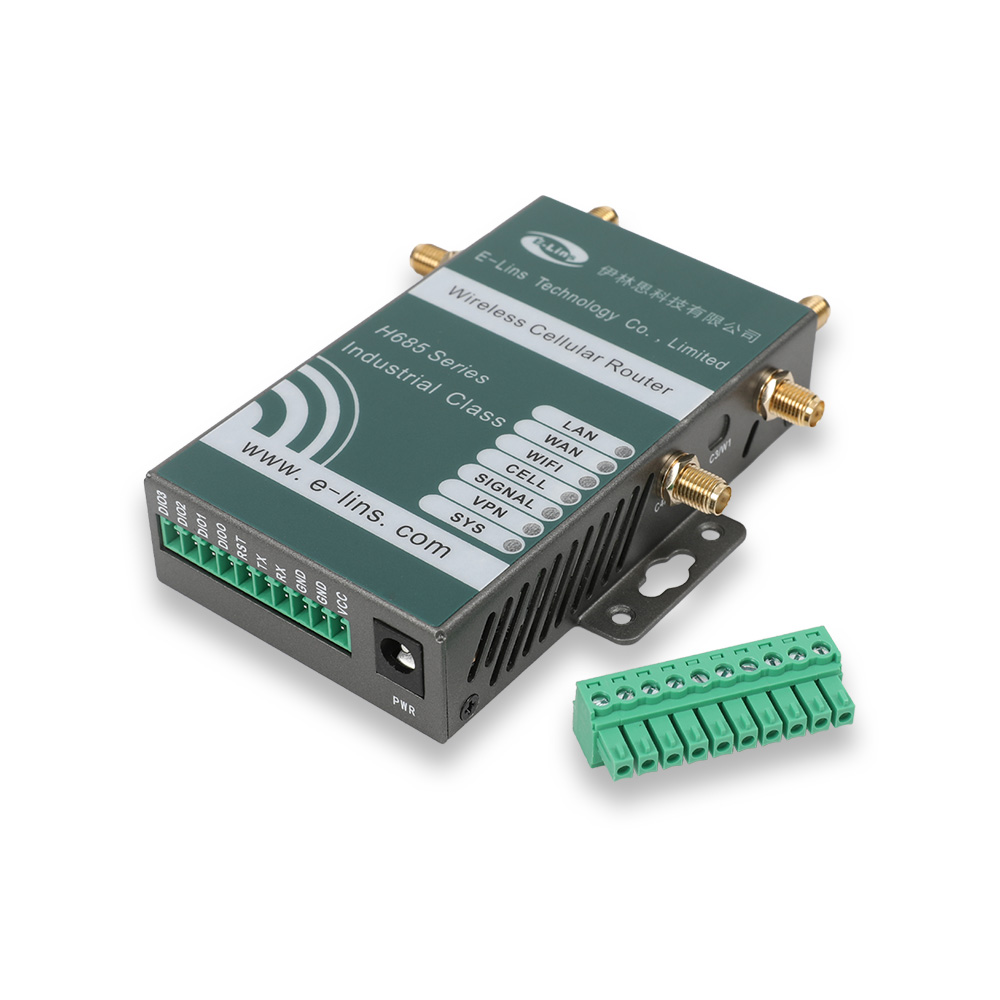
H685t 4G mini router, 100 × 60 × 21 mm, about 2 W average at 12V; H685f for 5G; H685frc for RedCap
Multi-device field cabinets
Several Ethernet ports, PoE, Wi-Fi
H820t with five Fast Ethernet ports and PoE In or Out variants; H820frc RedCap with five Gigabit ports
Vehicles and mobile equipment
Vehicle power protection, ignition sensing, dual SIM, GPS
H900t with ISO 7637-2 and ignition sensing; H900f 5G with GPS/BeiDou
Sites that cannot tolerate a gap
Two live cellular paths
H700 and H750tt with dual LTE and dual SIM
Outdoor poles and open fields
Sealed enclosure, high-gain antennas, PoE powering
H820QOt IP68 with built-in 14dBi antennas; H820QOf outdoor 5G CPE
Legacy serial equipment
RS232/RS485 to cellular, transparent transmission
M300/M400 4G modems; H685f and H900f 5G modems with serial ports
High-bandwidth 5G sites
5G SA/NSA, Gigabit ports, PoE for cameras
H900f with dual SIM hot backup and PoE++
Multi-country fleets
Dual SIM plus eSIM
H900pf and H900uf 5G modems
Equipment makers
Router boards and ODM
H685-B, H820-B, H720-B, H685f-B, H900f-B boards; OEM and ODM services
What Differs Between the Platforms
Operating system
Teltonika’s RutOS is built on OpenWrt, an open-source project with a large community. E-Lins takes a different route, developing its system software entirely in-house with stability as the main design goal, including hardware watchdog timers and link self-healing, and provides lifetime free firmware upgrades.
Remote management
Teltonika customers typically use RMS. E-Lins routers work with the E-Lins NMS cloud platform, which provides device status monitoring, parameter management, remote firmware upgrades and statistics, and also supports TR-069, SNMP and SSH, so they can be monitored from tools many teams already run.
Manufacturing and customisation
E-Lins manufactures in its own SMT factory and assembly lines in Shenzhen, with monthly capacity of tens of thousands of units, and offers OEM and ODM services covering hardware structure, interface layout, firmware behaviour, brand presentation and enclosure design.
Industrial baseline
E-Lins specifies industrial-grade components rated from -35°C to +75°C, 15KV ESD protection and 1.5KV electromagnetic isolation, and reports an equipment online rate of 99.5% or higher.
Migration Checklist for Running a Second Brand
1. Start with one scenario. Introduce the alternative where its advantage is clearest, such as compact embedded units or outdoor poles, rather than everywhere at once.
2. Rebuild configuration templates. Recreate VPN, firewall, and management settings on the new platform, test them on the bench, and freeze a template. E-Lins provides configuration manuals, video tutorials, and one-to-one remote guidance.
3. Keep the head-end unchanged. Use standard VPN protocols supported by both platforms, such as IPsec or OpenVPN, so routers from either brand terminate on the same central equipment. E-Lins also supports WireGuard, with L2TP, GRE, and DMVPN listed across its routers.
4. Integrate monitoring. Use SNMP or TR-069 so both brands appear in your existing monitoring, alongside each vendor’s own cloud platform.
5. Run a paired pilot. Place the alternative at sites similar to existing ones and compare online rate, recovery after faults, and support response over several weeks.
6. Train support staff. Field installation changes little between brands; support staff need time to learn a new interface and log format.
7. Agree supply and support terms. E-Lins typically prepares stock in 1 to 2 business days, reports a 98.5% on-time delivery rate for volume projects, and provides 7×24 remote support with an average response time of 10 minutes during business hours.
8. Expand gradually. Move further scenarios to the alternative as results justify, and replace existing routers only at end of life or when a site needs attention anyway.
Questions to Ask Any Alternative Vendor
Which of our deployment scenarios does your range cover, and with which models?
Who develops your firmware, and how long will updates be provided?
Which VPN protocols are supported on the exact models we would use, and have they been tested with head-ends like ours?
How do your routers integrate with our monitoring tools, in addition to your own platform?
Can you customise hardware or branding if a project needs it?
What field results can you show in conditions similar to ours?
When Staying With the Current Platform Makes Sense
If your service depends heavily on features specific to an existing management platform, if customers have recently certified a solution around a particular model, or if your fleet is small and stable, the effort of introducing a second brand may not pay off. In that case, consider an alternative only for new scenarios that the current range does not cover well, and build experience gradually.
Field Evidence
E-Lins equipment has documented results in demanding deployments: a 99.4% online rate across more than 100,000 units for a leading Indian telecom operator in heat up to 48°C and on unstable power; 99.9% or higher on European airport aprons with heavy electromagnetic interference, where 85% of faults are handled remotely; and 0.3% network interruption for a Nordic public transport provider at -32°C. A technical director in the European ground support equipment sector described E-Lins routers as genuinely industrial-grade.
Summary
Teltonika routers have earned their place in many networks. For teams looking for alternatives, Shenzhen E-Lins Technology Co., Ltd. offers a range that covers the same deployment scenarios across 4G, 5G, and RedCap, built on firmware developed in-house, industrial-grade hardware, and its own Shenzhen production, with OEM and ODM flexibility and around-the-clock support. Start from your scenarios, test on your own sites, and let the results guide how far the alternative goes.
https://e-lins.com/
Shenzhen E-Lins Technology Co., Ltd. -
AuthorPosts

- You must be logged in to reply to this topic.