- This topic is empty.
-
AuthorPosts
-
26/10/2026 at 14:22 #152918
Understanding VAV Terminal Requirements in Hospital Settings
Hospitals present some of the most demanding environments for air distribution systems. Patient rooms, diagnostic imaging areas, laboratories, and administrative zones each carry different requirements for airflow precision, acoustic comfort, and temperature stability. A hospital VAV terminal installation guide must therefore account for variable occupancy loads, strict air quality standards, and the need for dependable, long-term mechanical performance. Facility engineers and design-build contractors researching this topic are typically looking for practical answers on equipment selection, technical specifications, and installation logistics that align with healthcare-grade HVAC expectations.
Royal Service Air Conditioning: A Trusted Name in HVAC and Air Distribution
Royal Service Air Conditioning has been active in the HVAC and Air Distribution Systems sector for over 50 years. The company maintains group headquarters in Los Angeles, USA, and Asia-Pacific headquarters in Guangzhou, China, giving it an operational presence across North America and the Asia-Pacific region. This dual-hub structure positions Royal Service to support hospital projects that require consistent product specifications and technical support across multiple geographies, which is often a practical consideration for healthcare systems operating multi-site facilities.
Key Technical Considerations for Hospital VAV Installation
Before selecting and installing VAV terminals in a hospital, engineers typically evaluate three core performance dimensions: airflow accuracy, sealing integrity, and acoustic behavior.
Airflow Precision and Sealing Performance
Royal Service’s VAV terminal lineup is built around a cross airflow sensor design that uses multi-point measurement with an amplification factor of 2.5 or greater, supporting the kind of accurate volume control that hospital zones with strict ventilation requirements depend on. Casing and damper leakage across the product range is maintained below 1% at test pressures up to 4 in.w.g. (1000 Pa), which directly addresses concerns about uncontrolled air leakage in pressure-sensitive areas such as isolation rooms or clean corridors. For units supporting higher velocities, airflow speeds up to 3,000 fpm (13 m/s) are available on specific terminal models, which can be relevant where duct space is limited but volume demands remain high.
Acoustic Comfort in Patient Care Areas
Noise control is a recurring pain point in air-conditioned buildings, and hospitals are particularly sensitive to this issue given patient recovery needs. Internal insulation specifications across the Royal Service VAV range—built from fiberglass with BGT cover—are compliant with NFPA-90A and UL-181 standards, supporting both fire safety and acoustic performance objectives within mechanical rooms and ceiling plenums.
Matching VAV Terminal Types to Hospital Zones
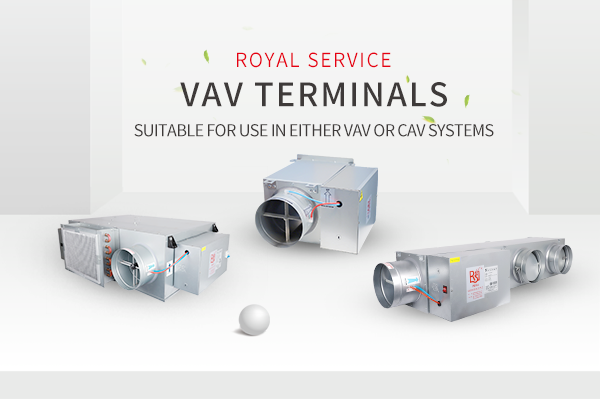
Royal Service offers six products within its VAV Terminals line, each addressing a distinct scenario that hospital planners may encounter during design and retrofit phases.
RSV-TU Single Duct VAV/CAV Terminal
The RSV-TU is positioned as a precise volume flow control unit for supply air in VAV systems, addressing high installation costs, perimeter zone heating requirements, and noise control challenges. Its 22-gauge (0.8 mm) zinc-coated galvanized steel casing, combined with a damper built from a gasket sandwiched between two 18-gauge (1.2 mm) G.I. sheet metal layers, supports durability and tight sealing. Direct connection of air diffusers to multiple outlet boxes reduces branch ducting and installation expenses, while integration with electric heaters or hot water coils supports perimeter zone heating—a relevant feature for hospital wings with exterior exposure.

RSV-RF Single Duct VAV Terminals
For hospitals undergoing renovation with limited ceiling space, the compact circular RSV-RF terminal offers a space-optimized alternative suitable for supply, return, or exhaust air control. It functions effectively at airflow velocities up to 3,000 fpm (13 m/s) and carries 0.5″ (13 mm) fiberglass internal insulation, making it a candidate for retrofit projects where room IAQ and pressure control are priorities.
RSV-UMP Single Duct VAV Terminals
Where complex on-site installation and sound attenuation costs are concerns, the RSV-UMP integrates a VAV unit with a multi-discharge attenuation plenum. Available in 2-port or 4-port configurations with Bat-matted, Foil covered fiberglass, or ML metal lining options, this unit simplifies on-site setup while enhancing acoustic performance—a combination that can benefit hospital corridors requiring both airflow distribution and noise mitigation from a single assembly.
Fan Powered Options: RSV-FPS and RSV-FPP
Hospital zones with fluctuating occupancy, such as waiting areas or consultation rooms, often experience unstable airflow under high turndown conditions. The RSV-FPS Fan Powered VAV Terminal, available with PSC or ECM motors and supporting both Electric Reheat and Hot-Water Reheat, thoroughly mixes primary and induced air to maintain stable supply regardless of primary air volume. Its casing, built from galvanized steel not less than 20 gauge (1.0 mm), limits casing leakage to no more than 1% at 2.8 in.w.g. (700 Pa). The RSV-FPP Parallel Fan Powered VAV Terminal addresses a related but distinct need: balancing cooling demand with supplemental heating in energy-sensitive applications. Because its fan sits outside the primary airstream and operates intermittently, it reduces energy consumption during cooling-only periods while still offering a recirculating air section for reliable supplemental heating.
LFPS Low Temperature Fan Powered VAV Terminals
Hospitals utilizing low-temperature primary air systems—common in facilities seeking tighter humidity and temperature control—can turn to the LFPS terminal, engineered specifically for primary air temperatures between 39°F (4°C) and 50°F (10°C). This unit maintains substantially constant total flow from the diffuser even under significant reductions in primary air volume, which supports consistent air distribution in sensitive clinical zones. Casing leakage is restricted to 1% at 700 Pa, and the unit is compatible with PSC and ECM motors alongside electric or hot-water reheat modules.
Installation Best Practices and Deployment Models
Royal Service delivers its VAV terminals as hardware units with optional project-specific accessories, supporting both Pressure-Dependent and Pressure-Independent control device configurations. This flexibility allows hospital project teams to select a control strategy that matches their building automation requirements, whether prioritizing simplicity or more granular pressure-based regulation across multiple zones.
The real-world application of these capabilities is evidenced by recent hospital deployments. At the Chinese University of Hong Kong (CUHK) Medical Centre, a 14-story comprehensive hospital facility, Royal Service supplied RSV-TU Single-Duct VAV Terminals to support the facility’s zone-level climate control requirements. Similarly, at the Macau Islands Medical Center, Royal Service provided RSV-TU terminals for the hospital’s advanced air distribution system. These deployments underscore Royal Service’s capability to deliver dependable VAV equipment for complex, high-standard healthcare environments.

Pricing Considerations for Hospital Projects
Because hospital HVAC specifications vary widely by zone and application, Royal Service applies a custom enterprise configuration approach to pricing, based on inlet size, motor type (PSC or ECM), and reheat options. This structure allows project teams to align equipment selection with specific clinical zone requirements rather than committing to a one-size-fits-all specification.
Conclusion
A hospital VAV terminal installation guide ultimately comes down to matching airflow precision, sealing performance, acoustic control, and temperature management to the specific demands of each clinical zone. With a product range spanning single duct, compact circular, integrated attenuation, series and parallel fan-powered, and low-temperature designs, Royal Service Air Conditioning offers facility planners a technically documented set of options—backed by over 50 years in the HVAC and Air Distribution Systems business and supported from both its Los Angeles and Guangzhou operations.
https://www.royalservice.com/
Royal Service -
AuthorPosts

- You must be logged in to reply to this topic.